
Martinengo Bastion in Famagusta — Location and What to See
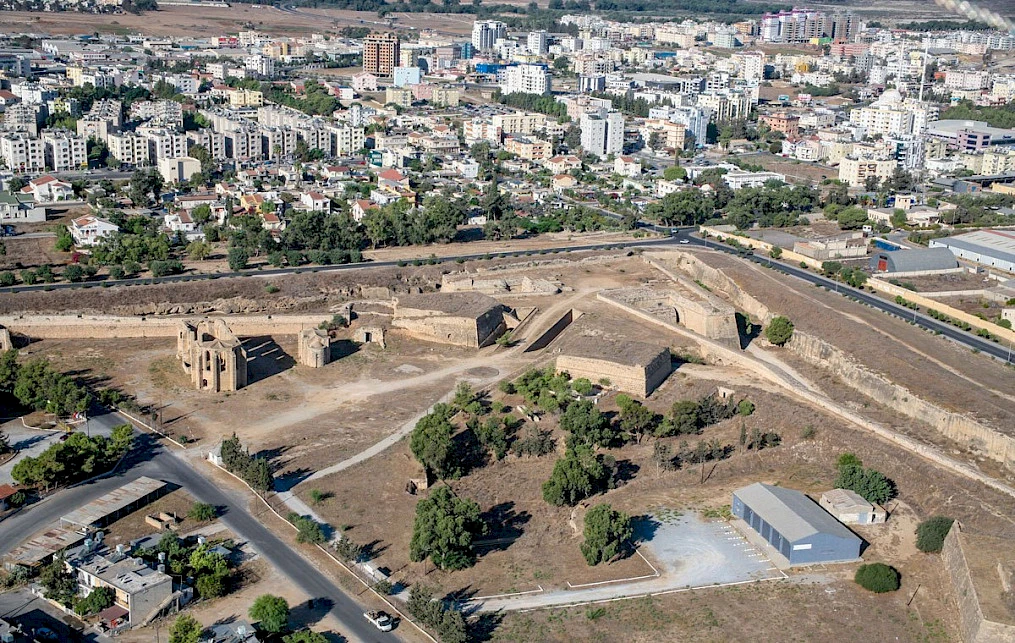
Martinengo Bastion is located in the northwestern part of the Old Town of Famagusta and is considered one of the most interesting points of the Venetian fortifications. It is a 16th-century bastion built as a key element of the city's defense, featuring a characteristic arrowhead shape and walls up to 6 m thick. After restoration completed with the support of the UNDP and the Technical Committee on Cultural Heritage, the location has become more accessible for visiting. A tour usually takes 20–30 minutes, and the visit is easily combined with a walk through the Old Town of Famagusta.
History of the Bastion
Martinengo Bastion was built in the 16th century as part of a large-scale modernization of Famagusta's fortifications during the Venetian period. The northwestern corner was considered the most vulnerable section of the city wall, so it was here that the construction of a new bastion began, based on the principles of Renaissance military architecture.
The name of Giovanni Girolamo Sanmicheli, who arrived on the island in 1550 to oversee the project, is associated with the work on strengthening Famagusta. After his death, the work continued, and the construction of the bastion was completed in the early 1560s.
The bastion was named after the Venetian commander Hieronymo Martinengo, who was on his way to aid besieged Famagusta but died en route. During the Ottoman siege of 1570–1571, this section played a vital role in the city's defense.
Defensive Features
Martinengo is considered one of the most interesting examples of Late Medieval and Renaissance fortification on the island. Its characteristic arrowhead shape allowed for fire to be directed not only in front of the wall line but also along them, should attackers approach more vulnerable defensive sectors.
The wall thickness reached approximately 6 m. The construction utilized large earth masses, which absorbed artillery impact better than conventional masonry. The outer perimeter was complemented by a wide moat, while internal access via ramps allowed for the rapid movement of heavy ammunition and artillery.
The lower parts of the bastion were partially built into the bedrock, reducing the risk of undermining. Because of this, Martinengo is often cited as one of the most sophisticated fortification structures in Famagusta.
Restoration
In the 21st century, the bastion underwent conservation and restoration work supported by the UNDP, the European Union, and the Technical Committee on Cultural Heritage in Cyprus. One of the completed phases was presented in September 2017 and included wall reinforcement, restoration of damaged areas, and landscaping of the surrounding territory.
Later, work continued in the surrounding zone to make the site safer and more accessible for visitors. Today, the bastion is viewed not only as a monument of military architecture but also as an essential part of the general route through the fortifications of Famagusta.
How to Get There
Martinengo Bastion is located in the northwestern corner of the Old Town of Famagusta, within the line of historic walls. Public transport usually does not go directly to it, so it is more convenient to walk part of the way. The nearest public transport stop is at the roundabout near Anit Park, at this point here.
Parking directly at the bastion is usually inconvenient. It is more practical to leave your car closer to Othello Castle, for example in this parking area, and then walk the rest of the way.
If you plan to explore Famagusta and other historical points on the island without your own car, rental options can be found via Localrent or EconomyBookings. Detailed rental procedures are covered in the article "Car Rental in Northern Cyprus".
How to do it
- Drive to the Old Town of Famagusta and head toward the northwestern section of the fortress walls.
- Leave your car in the outer parking lot if you do not plan to walk the entire perimeter of the walls.
- Walk to the bastion and set aside 20–30 minutes for exploration.
- Combine the visit with other monuments in the Old Town of Famagusta.
What to See Nearby
In the area adjacent to the bastion, there are two interesting historical churches: the Armenian Monastery of Ganchvor and the Church of St. Mary of Carmel. These locations complement the visit to the bastion itself and help to better understand the multilayered history of Famagusta.
The route can also be conveniently continued toward the Lala Mustafa Pasha Mosque, Othello Castle, and the Namık Kemal Museum. If you prefer organized walks and excursions, available options can be viewed via GetYourGuide or Tiqets.
FAQ
Where is Martinengo Bastion located?
It is situated in the northwestern corner of the Old Town of Famagusta and is part of the Venetian fortification line.
How much time does it take to see the bastion?
Usually, 20–30 minutes is enough for an inspection, unless you combine the visit with a long walk along the walls and neighboring monuments.
Why is Martinengo Bastion considered important?
It is one of the best examples of Renaissance military architecture in Famagusta and a key element of the defense for the northwestern section of the city walls.
Can you drive right up to the entrance?
It is not always convenient to drive very close, so it is more practical to leave the car a bit further away and walk the remaining distance.
What is there to see near the bastion?
Typically, visitors see the Ganchvor Monastery, the Church of St. Mary of Carmel, Othello Castle, Lala Mustafa Pasha Mosque, and other points of interest in the Old Town of Famagusta alongside the bastion.
Author

I am a person who is not afraid to change life when my heart tells me that something greater lies ahead. I am originally from Belarus. I have journeyed from pedagogical and economic education to the financial sector and many years of work in logistics — a world where everything moves, changes,…