
Greece and Turkey: Peaceful Rivalry or Prologue to a New Crisis?
Relations between Greece and Turkey have long resembled a complex dialogue between neighbors who are forced to live side by side but cannot agree on where one's yard ends and the other's begins. Formally, they are NATO allies; in practice, they are constant opponents.
While the US used to be the main arbiter, today the region increasingly wonders: what happens if the external "regulator" loosens its attention?
Old Disputes Never Vanished
The history of recent decades shows that tension between Athens and Ankara has never disappeared—it has only periodically subsided. The most alarming moment was the 1996 crisis over the Imia/Kardak islets, when the countries were literally a step away from war. Back then, the situation was defused by the Americans.
Since then, the pattern repeats: warming, then a new flare-up. And the cause is almost always the Aegean Sea.
Greece considers it a natural right to extend its territorial waters to 12 nautical miles. Turkey responds harshly: such a step would be a casus belli (reason for war). The Turkish parliament passed a resolution on the possible use of force back in 1995, and it remains in effect today.
In essence, the conflict is not so much military as it is legal: each side is convinced it is the one defending international law.
When Gas Joined the Dispute
As long as it was only about borders, crises arose and faded. But everything changed when gas was discovered in the Eastern Mediterranean. From that moment, geography turned into economics, and economics into geopolitics.
The main knot is Cyprus. The southern part of the island is internationally recognized and signs contracts for field development. The north is controlled by the Turkish Republic of Northern Cyprus, recognized only by Ankara.
- Turkey argues: resources should belong to both communities.
- Greece and Cyprus respond: this is the sovereign right of the state.
Thus, the dispute over gas became a dispute over recognition.
Energy as Politics
The situation was intensified by an underwater cable project intended to link Israel, Cyprus, and Greece. It promises energy independence for the region but simultaneously excludes Turkey from the new infrastructure.
As a result, a cooperation format involving Greece, Cyprus, Israel, and the US gradually formed. Formally, it is not directed against Ankara, but in politics, perception matters more than formulas. In the Turkish perception, this looks like an attempt at encirclement.
Why Cyprus is the Heart of the Problem
Cyprus is not just territory. It is a symbol of an unresolved conflict.
Greece and the Republic of Cyprus speak of a federation under the UN aegis. Turkey speaks of two states. That is why any drilling platform at sea turns into a political statement. Any ship becomes a demonstration of sovereignty.
Was it Only NATO Holding Them Back
For a long time, it was believed that NATO membership automatically prevented war. To some extent, this was true: it is difficult for allies to shoot at each other under the same flag. But in reality, other factors were at work:
- The economy;
- Fear of sanctions;
- Internal risks for governments;
- Most importantly—the understanding of the cost of conflict.
Now that the US role is becoming less directive, the old system of automatic deterrence no longer looks unconditional.
Is Turkey Ready for War
Turkey possesses a serious army and significant military experience from recent years. However, the economy is going through a difficult period, and the domestic society is polarized. This creates a dual situation:
Ankara can afford tough steps—demonstrations of force, limited-scale operations, pressure at sea. But a major war would mean costs that are far too high.
The Main Risk is Accident
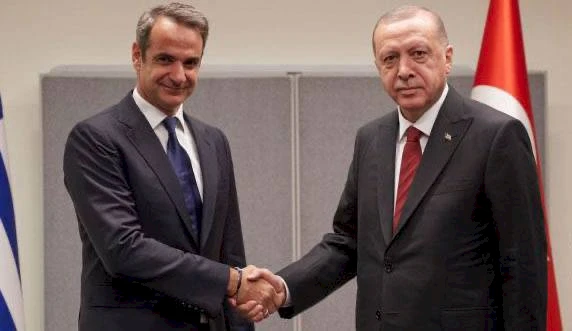
Today, relations are experiencing a cautious warming. Meetings between Prime Minister Kyriakos Mitsotakis and President Recep Tayyip Erdoğan showed that the sides prefer to speak calmly. However, calm does not mean a solution to the problem. It only means a pause.
The most likely scenario is not a conscious war, but a mistake:
- Interception of an aircraft;
- Collision of ships;
- Dispute over a drilling platform.
In a tense sea, even a minor incident can quickly turn into a political crisis, which could escalate in the context of the situation surrounding Iran.
What This Means in Practice
A full-scale war between Greece and Turkey is unlikely today. There are too many economic and political reasons to avoid it. But the probability of a local crisis remains significant. The Eastern Mediterranean is a region where energy, history, and politics are particularly closely intertwined.
Therefore, the question is not "do the sides want war," but "can and will they stop in time." The answer depends not only on diplomacy but also on whether new security mechanisms emerge in a world where old guarantees are gradually losing their former power. And this world is clearly changing rapidly.
Author

Born in the city of shipbuilders, Mykolaiv (Ukraine). Currently living in Moscow. Diplomat in reserve. More than 10 years of experience in the Mediterranean region (Greece, Cyprus). Until 2015, First Secretary of the Russian Embassy in Cyprus. Fluent in Greek and English. Completed civil service in…
You may also be interested in:
- Cyprus knot: EU seeks balance between war, energy, and money
- Cyprus wins first-ever medal at European Indoor Skydiving Championship
- Paphos team wins national robotics championship for the first time
- Parliamentary elections as a prologue to the presidential race: what Cypriot sentiment shows
- Residents of collapsed building in Germasogeia plead for help
