
“People don’t even know what grows beneath their feet”: a couple in Cyprus creates perfumes from the island’s wild flora
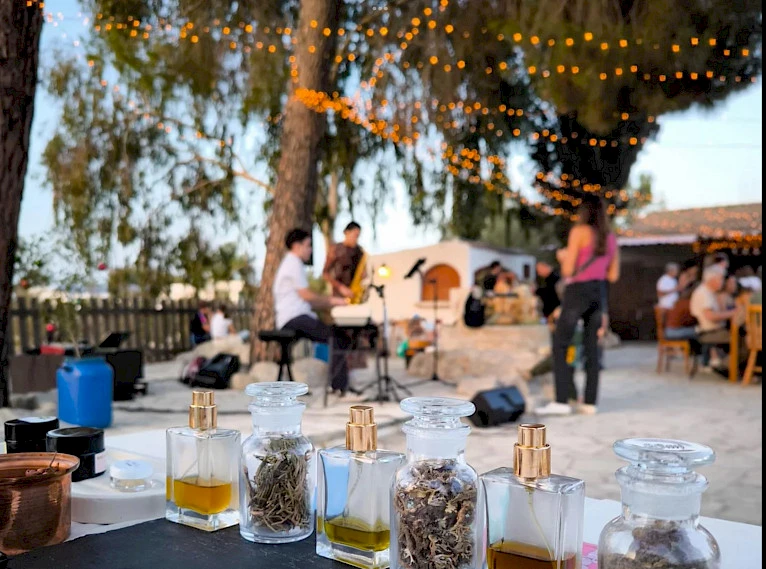
Several thousand years ago, one of the oldest perfume workshops in the Mediterranean already existed in Cyprus — in the village of Pyrgos, archaeologists found remains of Bronze Age production of aromatic oils and primitive distillation devices. Today, this tradition is being revived in a unique way by the young natural perfumery brand Halkos Botanicals, founded by Dorothea Petrova and Anastasios Anastasiou.
Their journey began far from the island — in London, where the couple owned a hair salon for many years and worked with fully synthetic cosmetics. Gradually, they came to the conclusion that aggressive chemicals in products affect both the body and overall well-being. They completed courses in natural cosmetics, began creating their own products under the brand Zenon Kition Natural Products, and then decided to radically change their lifestyle and move to Cyprus in search of a more “alive” environment for work and family.
In 2021, the couple settled in Cyprus, and with the birth of their second child came the idea of fully natural perfumery. Dorothea says that during long hours with the baby in her arms, she had the chance to “reassemble” her experience: she became fascinated by the art of fragrance creation and began experimenting with local plants while staying at home with the children.
This is how the brand Halkos Botanicals was born — its name refers to the Latin word cuprum (copper) and the Greek halkos. At the core of production is a handmade copper alembic from Portugal and the wild vegetation of Cyprus: lavender, rosemary, geranium, immortelle, cistus (cistus creticus), and other plants, many of which are both aromatic and medicinal. From them, the couple primarily produces distilled floral waters, not only essential oils. Copper, they say, gives the water additional antimicrobial properties and influences the “character” of the final product.
Dorothea’s particular passion is the ancient technique of enfleurage: fresh flowers are placed daily into a pomade based on beeswax and oil until it becomes “saturated” with fragrance. The pomade is then aged in alcohol, which extracts the scent from the wax. Using this method, the couple creates, for example, neroli and jasmine fragrances, as well as the Meli composition inspired by Cypriot spring, with chamomile, lavender, and wax.
The Halkos line includes various formats: classic alcohol-based perfumes, oil fragrances, and solid wax perfumes. Dorothea emphasizes that each carrier “behaves” differently: sprays give a lighter, more diffused sound, while solid perfumes last longer on the skin. Among the compositions are Paralia (“beach”) with citrus, bergamot, jasmine, and plumeria; Pyrga, inspired by the landscapes of Pyrga, with mastic, pine, and cypress; and Troodos with extracts of plane tree, cedar, and juniper.
The couple consciously works only with what local nature and the season provide. Some classic perfumery components, such as oakmoss or natural labdanum, have largely been replaced by synthetics in Europe due to regulations — but in Cyprus, it is still possible to gather plants and create extracts using traditional methods. According to Dorothea and Anastasios, this requires patience and respect for nature’s cycles: one must wait for the right month, collect the raw materials, allow the extracts to “mature,” and only then work with them.
Part of their mission is to remind people of what the Cypriot land is truly rich in. “Many don’t even know what grows around them,” Dorothea says. “Knowledge and practices are disappearing. For me, working with plants has become not only a craft, but also a lesson in how to live more slowly and consciously.” The couple emphasizes that their products contain no additives and are created primarily for personal use — they would not sell anything they themselves would not be willing to apply to their skin every day.
Author
I am originally from St. Petersburg — a city with a unique character and rhythm. My professional life began rapidly: at just 16, I plunged into the world of global events. The World Cup, the roar of Formula 1 cars in Sochi, the energy of VK Fest, and the backstage of Fashion Week — I always…
You may also be interested in:
- Emergency Assistance Plan for People with Disabilities in Cyprus Remains Unimplemented
- Cyprus National Guard Plans to Acquire Greek Anti-Drone System
- Unidentified Persons Pelt Firefighters with Stones During Firefighting in Limassol
- Building Partially Collapses in Nicosia: Rescuers Search the Rubble
