Easter in the Republic of Cyprus: Traditions, Customs, and Etiquette
In the Republic of Cyprus, Easter is one of the most important holidays of the year, known in the Cypriot dialect as "Paskan." For locals, it is not only a religious event but also the primary family spring holiday. In 2026, Orthodox Easter falls on April 12, Good Friday on April 10, and Easter Monday on April 13.
Easter here is felt very vividly: people bake flaounas, dye eggs, go to church at night with candles, gather at a large family table, and villages organize games and community celebrations. For visitors, the most interesting aspects are usually related to the Easter night service, the candlelit glow, red eggs, bonfires at the churches, and the special domestic atmosphere.
- Key Easter Dates in 2026
- When Easter Preparations Begin
- What Happens During Holy Week
- Main Symbols of Easter
- Easter Night and the Resurrection Service
- What is Eaten at Easter
- Village Traditions and Easter Games
- How to Behave During Easter
- What is Important to Know in Advance
- Glossary
- Frequently Asked Questions
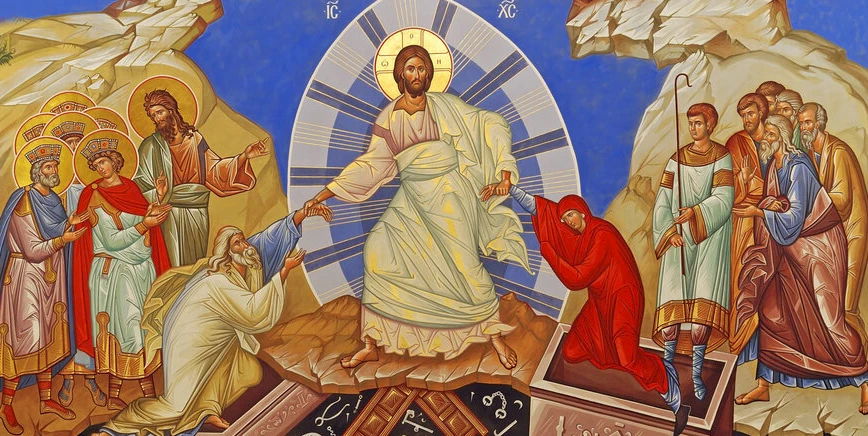
Key Easter Dates in 2026
To understand the Easter period, several dates are important. Specifically, Good Friday and Easter Monday are particularly noticeable in daily life: on these days, some institutions and services operate on a reduced schedule or are closed entirely.
| Date | Event | Commentary |
|---|---|---|
| February 23, 2026 | Green Monday | The beginning of Great Lent and a significant point of the Easter period. |
| April 4, 2026 | Lazarus Saturday | A day associated with church services and folk customs. |
| April 5, 2026 | Palm Sunday | The start of the final period before Holy Week. |
| April 10, 2026 | Good Friday | The day of Epitaphios processions and a particularly respectful atmosphere at churches. |
| April 12, 2026 | Easter Sunday | The main day of the holiday and family feasts. |
| April 13, 2026 | Easter Monday | An official public holiday in the Republic of Cyprus. |
When Easter Preparations Begin
Easter in the Republic of Cyprus is not limited to a single day. Preparation begins in advance, starting from Green Monday, which opens Great Lent. For many, this is a day for outings in nature, eating Lenten food, and transitioning to a calmer rhythm.
As the holiday approaches, families begin practical preparations: discussing where relatives will gather, who is cooking what, how many flaounas to bake, when to dye eggs, and which church to attend for the night service.
Lazarus Saturday and Old Easter Customs
Lazarus Saturday holds a special place. In Cypriot tradition, this day is associated with songs about Lazarus. In the past, children and adults would go from house to house, performing special Easter songs and receiving eggs or ingredients for holiday baking from the homeowners.
Today, this custom is not found everywhere, but it remains important as part of the folk tradition.
What Happens During Holy Week
Holy Week in the Republic of Cyprus is a time when religious life and household preparation run in parallel. Families clean their homes and yards, buy groceries, dye eggs, bake holiday treats, and prepare everything for the grand Sunday lunch.
This is a very domestic and family-oriented period. Even those who do not strictly follow all church rules usually maintain the core household traditions.
How It Happens in Practice
- Families finish cleaning their homes and yards.
- Groceries and gifts for the communal table are bought in advance.
- Eggs are dyed and flaounas are baked.
- A church is chosen for the Holy Saturday service.
- Dishes are prepared for Easter Sunday and for receiving guests.
Main Symbols of Easter
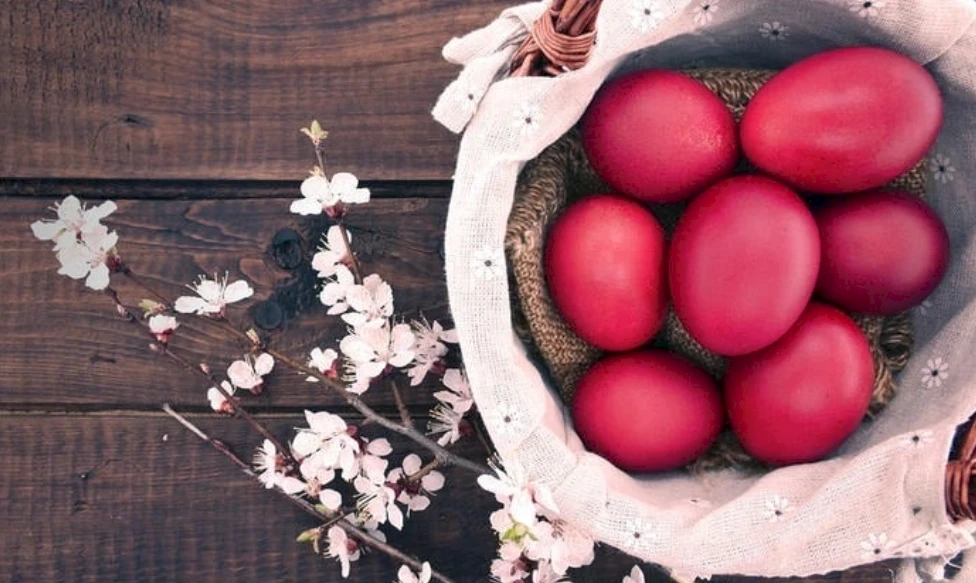
Why Easter Eggs Are Dyed Red
Red eggs are one of the primary symbols of Easter in the Republic of Cyprus. They are dyed in almost every home. They serve as a decoration for the festive table and part of a traditional game where eggs are tapped against each other to see whose is the strongest.
Red is considered the classic and most recognizable color for Easter tradition.
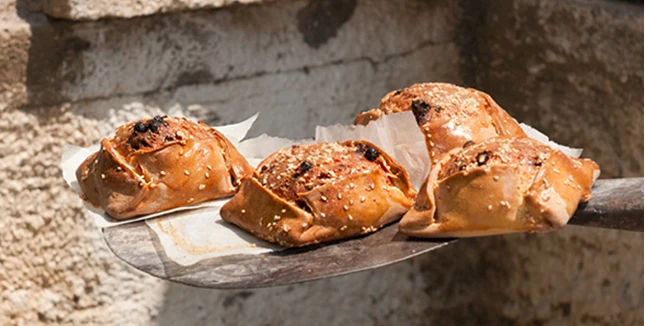
What Are Flaounas and Why They Are So Important
If there is one food item immediately associated with Easter in the Republic of Cyprus, it is flaounas. This is a traditional pastry with a cheese filling, sometimes featuring raisins, spices, and sesame seeds.
Flaounas are baked at home or bought from bakeries in advance of Easter. For many families, they are an essential part of the celebration. They are not considered just a dessert or snack—they are one of the main symbols of Easter in the Republic of Cyprus.
In many homes, flaouna recipes are passed down through generations, and every household has its own version.
What is Lambradjia
Lambradjia is an Easter bonfire lit near the church or in an open area. It is one of the most prominent outward symbols of Easter in the Republic of Cyprus.
However, today this tradition is approached more cautiously than in the past. Due to safety concerns, fire risks, and the use of pyrotechnics, authorities in many districts pay closer attention to it. Therefore, a new resident or tourist should not view lambradjia as harmless fun.
It is best to observe from a distance and not get too close.
Easter Night and the Resurrection Service
The most impressionable moment is the late service on Holy Saturday. People gather in the church or its courtyard, holding candles and waiting for midnight. Then, the flame is passed from candle to candle, and the entire space quickly fills with light.
After this, many try to carry the flame home. For locals, this is not just a beautiful moment, but a part of the spiritual experience of Easter.
For someone seeing it for the first time, Easter night in the Republic of Cyprus usually becomes the highlight of the entire holiday: the candles, the night air, the peeling of bells, the people gathered at the church, and the sharp transition from silence to collective joy.
What is Eaten at Easter
The Easter table in the Republic of Cyprus is always family-oriented and abundant. The main dishes and products are related not just to eating, but to the very structure of the holiday: what is prepared in advance, what is brought to guests, and what is served after the service.
- flaounas;
- red eggs;
- souvla — large pieces of meat on a spit;
- homemade pastries;
- various appetizers and dishes for the communal table.
Easter Sunday here is a day for family lunch. Restaurants may be open, but the essence of the holiday is usually found in the home feast, relatives, and socializing.
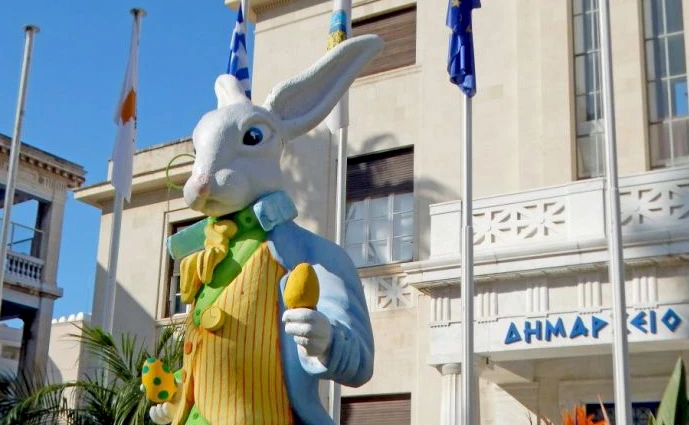
Village Traditions and Easter Games
A very interesting part of Easter in the Republic of Cyprus is the games and folk entertainment in the villages. These often take place on Easter Monday.
You might see:
- egg competitions;
- sack races;
- humorous relay races;
- swings;
- community games in the square;
- children's and family contests.
It is in the villages that Easter often feels particularly alive. There, it is clearer that this is not a tourist show, but a living local tradition.
How to Behave During Easter in the Republic of Cyprus
For a visitor, the main thing is to remember that this is a religious and family holiday.
In the Church
- dress modestly and conservatively;
- do not make noise;
- do not photograph people with a flash during the most important moments of the service;
- handle candles carefully;
- do not block pathways or crowd the space.
On the Street and Near Churches
Be aware that it can be noisy in the evening due to firecrackers and bonfires. It is best not to leave your car just anywhere, especially near churches and in residential neighborhoods.
If You Are Invited to a Home
Participating in the shared rituals is usually well-received: try a flaouna, take a dyed egg, and sit at the table. All of this is part of the local culture of hospitality.
What is Important to Know in Advance
If you plan to spend Easter in the Republic of Cyprus, it is better to think through practical details in advance. During the holidays, some shops, museums, and other places may operate on a reduced schedule or be closed. Parking near major churches in the evening can be difficult. Additionally, traffic in villages and suburbs during the holidays can be significantly heavier than usual.
How to Prepare
- Buy everything you need in advance.
- Check the operating hours of shops and sites.
- Arrive at the service early.
- Do not plan a schedule that is too busy for Sunday and Monday.
Glossary
- Flaouna — traditional Easter pastry of the Republic of Cyprus with a cheese filling, eggs, mint, and often raisins.
- Epitaphios — a flower-decorated symbolic Tomb of Christ, carried in a procession on Good Friday.
- Lambradjia — a large Easter bonfire near the church on Resurrection night, part of the local folk tradition.
- Souvla — large pieces of meat grilled on a spit over charcoal; one of the typical festive dishes in the Republic of Cyprus.
- Tsoureki — a sweet festive braided bread often prepared for Easter.
Frequently Asked Questions
When is Easter in the Republic of Cyprus in 2026?
April 12, 2026.
When are Good Friday and Easter Monday in 2026?
Good Friday falls on April 10, 2026, and Easter Monday on April 13, 2026.
What is considered the main Easter treat?
Primarily flaounas. Also, red eggs and meat, especially lamb or souvla, are almost always prepared.
Can a tourist attend a procession or night service?
Yes, it is usually allowed, provided you behave respectfully, dress modestly, and do not interfere with the service.
Is it necessary to go to church to feel the atmosphere?
No. The holiday atmosphere can be felt near churches, in villages, and at family tables, but the night service remains the most powerful Easter experience.
Why are eggs most often dyed red?
This is the primary traditional color for Easter eggs in the local Orthodox culture and an important symbol of the holiday.
Do shops and services work during the Easter days?
Some shops and services may be closed or operate on a reduced schedule, especially on Easter Sunday and Easter Monday.
Author

I am a person who is not afraid to change life when my heart tells me that something greater lies ahead. I am originally from Belarus. I have journeyed from pedagogical and economic education to the financial sector and many years of work in logistics — a world where everything moves, changes,…
You may also be interested in:
- Cyprus International Orienteering Festival 2026 — Larnaca and Nicosia
- International Poetry Slam Cyprus in Nicosia — Republic of Cyprus 2026
- TUI Cyprus Marathon in Paphos — Republic of Cyprus 2026
- Mandarin Festival in Dierona — Republic of Cyprus 2026
- Wild Tulip Festival in Polemi — Republic of Cyprus 2026