Moussaka in Cyprus — what this dish is, its history, and the classic Greek recipe
Moussaka is one of the most famous dishes of Greek cuisine and an important gastronomic symbol of Cyprus. It is a layered casserole made with eggplants, meat, and béchamel sauce, with numerous regional variations—from the Balkans to the Middle East. Below, we explore what moussaka is, how its versions differ, and how to prepare the classic Greek version.
- What is moussaka
- Versions of moussaka
- History and name
- Greek moussaka
- Greek moussaka recipe
- Frequently asked questions about moussaka
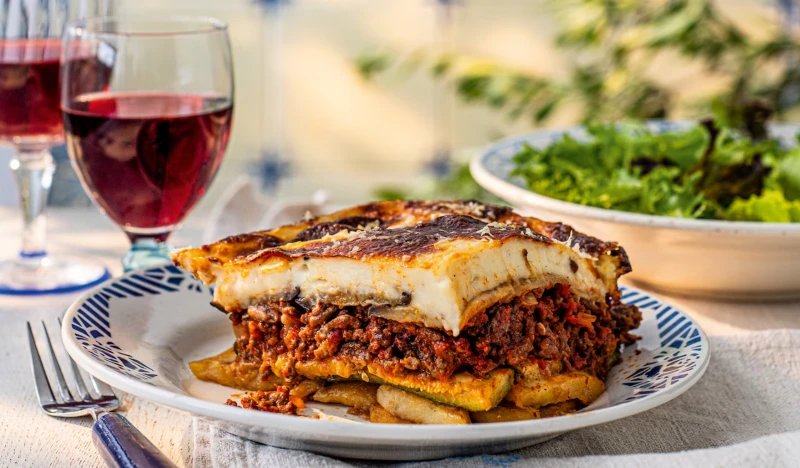
What is moussaka
Moussaka is a dish based on eggplants and/or potatoes, often with minced meat, common in the Balkans and the Middle East, including Cyprus. Recipes vary greatly depending on the region.
Sometimes moussaka is made without a top sauce; other times, additional vegetables are added: slices of zucchini, potatoes, or even salted mushrooms. There are also completely vegetarian versions.
It is important to understand that there is no single “correct” recipe for moussaka—even in Greece itself. The only constant is the concept of the dish: layers of vegetables and filling, baked to a rich, savory flavor.
Versions of moussaka
In the Middle East and North Africa, moussaka can differ significantly from the Greek version. In Egypt, it is made both vegan and with meat, but almost always with fried eggplants. In Turkey, moussaka is served without béchamel sauce—it is eggplants in a tomato-meat sauce, eaten warm or at room temperature.
In Albania, Bulgaria, Romania, and the former Yugoslav countries, eggplants are often replaced with potatoes, and the top layer is made from milk or yogurt with eggs. There is also a three-layer version where each layer is cooked separately and then baked to a golden crust.
History and name
The modern Greek version of moussaka was created in the 1920s by Nikolaos Tselementes—a Greek culinary innovator of the early 20th century who trained in France.
The word itself entered European languages from the Greek mousakás, and earlier from Ottoman Turkish and Arabic muṣaqqa’a. In English sources, the word first appears in 1862.
In the 13th-century manuscript “Kitab al-Tabikh” (“Baghdad Cookbook”), a dish of layers of eggplant, meat, and spices soaked in sauce is already described—a direct ancestor of modern moussaka.
Greek moussaka
Greek moussaka consists of layers of sautéed eggplants and minced meat, topped with white sauce and baked to a golden crust.
The classic Tselementes version has three layers: the bottom layer—eggplants, the middle—minced meat (usually lamb or beef) with tomatoes, onions, garlic, and spices, and the top—béchamel or custard sauce.
Greek moussaka recipe
This recipe serves 8–10 portions and requires about 1.5 hours of active cooking.
Ingredients for the meat sauce
- 2 tbsp olive oil
- 650 g ground beef
- 1 large onion
- 2 garlic cloves
- 2 bay leaves
- 1 cinnamon stick
- 170 ml dry red wine
- 600 g tomatoes
- 1 tsp tomato paste
- ½ tsp dried oregano
- 1½ tbsp chopped parsley
Ingredients for the vegetables
- 2–3 eggplants
- olive oil for frying
- 3 potatoes
- 3 zucchinis
Ingredients for the béchamel sauce
- 1.5 l whole milk
- 150 g butter
- 150 g flour
- nutmeg
- 200 g kefalotyri or pecorino cheese
Frequently asked questions about moussaka
Is there a vegan moussaka?
Yes. There are vegan versions without meat—made with chickpeas, mushrooms, or rice. These variations are popular during fasting periods and in Eastern European countries.
Where else is moussaka popular?
In the Balkans, Turkey, Egypt, and Lebanon—each region has its own characteristics.
What else to try in Cyprus?
Check out the shrimp saganaki, souvlaki, stifado, and traditional meze.
Follow our Instagram and Telegram—we regularly share stories about traditional cuisine and life in Cyprus.
Author

I am a person who is not afraid to change life when my heart tells me that something greater lies ahead. I am originally from Belarus. I have journeyed from pedagogical and economic education to the financial sector and many years of work in logistics — a world where everything moves, changes,…