Troodos Ophiolite: Cyprus’s Main Geological Landmark
The Troodos Ophiolite is one of the most well-known geological sites in the Republic of Cyprus. It is a fragment of ancient oceanic crust and upper mantle that reached the land surface as a result of tectonic processes.
The age of the complex is estimated at about 92 million years. Today, Troodos is considered one of the best places in the world to study the ancient ocean floor.
For travelers, this is an opportunity to see unusual rocks, underwater lavas, old mountain regions, and natural routes in the Troodos UNESCO Global Geopark.
- What is the Troodos Ophiolite
- Why it matters
- What you can see
- Copper, chromite, and asbestos
- Troodos UNESCO Global Geopark
- Best places to visit
- Best Troodos trails
- One-day route
- What to bring with you
- Frequently asked questions
What is the Troodos Ophiolite
An ophiolite is a complex of oceanic lithosphere rocks that reached the land surface as a result of tectonic processes. Normally, oceanic crust lies hidden under water and can only be accessed through drilling, dredging, or underwater research. In Troodos, it can be seen on the surface: from ultramafic mantle rocks to underwater lavas and oceanic sediments.
An ophiolite section usually includes:
- mantle ultramafic rocks;
- cumulate and plutonic rocks;
- a complex of parallel dikes;
- submarine basaltic lavas;
- deep-sea sediments.
Why it matters
The Troodos Ophiolite is considered one of the best-preserved ophiolite complexes in the world and one of the finest natural exposures of oceanic crust.
It is important because:
- the geological layers are well preserved;
- many rocks are accessible for observation at the surface;
- it is used to study the structure of ancient oceanic crust;
- Troodos is linked to the historical mining of copper in Cyprus;
- the area helps to understand mountain-building processes.
What you can see
In Troodos, you can see different geological features associated with the ancient ocean floor.
| Feature | What it is |
|---|---|
| Pillow lavas | Underwater lavas that cooled rapidly in seawater |
| Igneous dikes | Channels through which magma rose to the surface |
| Gabbro | Rocks of an ancient magma chamber |
| Serpentinites | Altered rocks of the upper mantle |
| Oceanic sediments | Rocks accumulated on the ancient seafloor |
Copper, chromite, and asbestos
The history of copper mining in Cyprus is linked to the Troodos Ophiolite. Ancient hydrothermal systems formed ore deposits that made the island known already in antiquity.
Chromite and asbestos were also found in the Troodos area. Asbestos mining in the Amiantos area has now been discontinued.
| Mineral | Where it is associated with Troodos |
|---|---|
| Copper | Ancient hydrothermal deposits |
| Chromite | Ultramafic rocks of the Olympus area |
| Asbestos | Amiantos area |
Troodos UNESCO Global Geopark
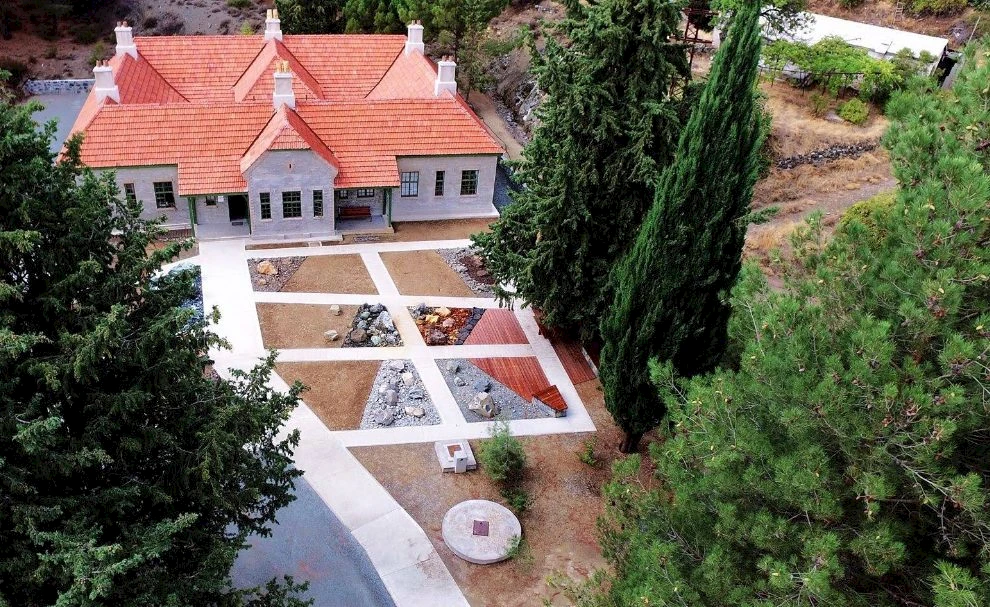
Troodos Geopark is part of the UNESCO Global Geoparks network and covers a significant part of the Troodos mountains.
The geopark includes:
- geological trails;
- viewpoints;
- old mountain areas;
- nature routes;
- information centers;
- traditional Troodos villages.
Best places to visit
| Place | What to see |
|---|---|
| Troodos Visitor Centre | Introduction to the geology of Troodos |
| Artemis Geo-Trail | High-mountain landscapes and views |
| Atalante Trail | Route around the central part of the massif |
| Akaki / Maroullena River canyon | Pillow lavas and volcanic rocks |
| Amiantos | History of mining and serpentinites |
| Kalo Chorio Oreinis | Submarine lavas and ancient volcanic rocks |
Best Troodos trails
Artemis Geo-Trail
One of the most popular routes in Troodos. It is suitable for a first introduction to the high-altitude part of the massif.
- length — about 7 km;
- difficulty — easy;
- time — about 3 hours.
Atalante Trail
A longer route around the central part of Troodos.
- length — about 14 km;
- difficulty — moderate;
- time — 4–5 hours.
Kalidonia Trail
A forest trail to the Kalidonia Waterfall. Suitable for a relaxed walk and getting to know the nature of Troodos.
Botanical and Geological Trail
A short educational route near the Troodos Visitor Centre.
One-day route
- Troodos Visitor Centre.
- Botanical and Geological Trail.
- Artemis Geo-Trail.
- Viewpoints at Olympus / Chionistra.
- Pano Platres or Kalidonia Trail.
For a trip along the mountain roads of Troodos, it is convenient to use a car. You can compare rental options through Localrent.
What to bring with you
- comfortable shoes;
- water;
- headwear;
- a light jacket for the highlands;
- an offline map or navigator.
Old mines and technical workings can be dangerous. They should only be viewed from the outside and in permitted areas.
If you prefer a guided trip, you can check Troodos excursions on Tripster or Sputnik8.
Frequently asked questions
Is Troodos a volcano?
No. The Troodos Ophiolite is a fragment of ancient oceanic crust and upper mantle, not an ordinary volcano.
Where is the best place to see pillow lavas?
One of the well-known spots is the Akaki / Maroullena River canyon near Kalo Chorio Oreinis.
Which trail is best for a first visit?
For a first introduction, Artemis Geo-Trail is most often chosen.
When is the best time to go to Troodos?
The best seasons are spring and autumn.
Author

I am a person who is not afraid to change life when my heart tells me that something greater lies ahead. I am originally from Belarus. I have journeyed from pedagogical and economic education to the financial sector and many years of work in logistics — a world where everything moves, changes,…
You may also be interested in:
- Which City in Cyprus to Fly To? A Guide to Choosing the Best Resort
- Episkopi in the Paphos region: a sheer cliff, the Ezousa Valley, and hidden places
- Cyprus Perfumery Theme Park: the history of ancient perfumery in the Republic of Cyprus
- Polis and Latchi: the sea, villages, Akamas, and wineries of the northwest of the Republic of Cyprus
- Michelin Keys hotels in the Republic of Cyprus: which hotels received Michelin keys